Tuesday, 20 April 2010

Bare Street, Bare House


For the exhibition Bare House in Pori, opening May 28, I will present posters with some drawings, and with some of my Ulaanbaatar diaries (Blog extracts)

Wednesday, 7 April 2010

paviljonki 3


paviljonki 3
Originally uploaded by neppanen
A Bare House

Trolleybus, Ulaanbaatar Street

Bare Street, Ulaanbaatar

Ulaanbaatar Trolley
Originally uploaded by AaverageJoe

Shop Sign, Street and Public Transport by Michael Chu

Bare House


The proposed contribution for Bare House, in Pori this May - to be called Улаанбаатарийн Гудамчнууд or alternatively 'Bare Street' - is concerned with urbanisation and the informal peri-urban environments of Ulaanbaatar. The informal districts of Ulaanbaatar (known as гэр хооролол) are expanding due to internal migration following the recent extreme winter 'zuud', which has damaged rural livelihoods. A series of six banners of urban landscapes (printed using a local UB technique for making shop signage) forms one part, a small drawing studio / installation with pencil drawings, sketchbooks and a blog forms another. The weblog diary and sketches document the work and day-to-day life of a certain 'nomadologist', an architect teacher trainer in a peri-urban construction college, walking from the edge of the formal city through a 'ger district' to a training college and live construction site. Some features of the year-long blog include Live Projects , Participation, Sustainable Tourism, and a wheelchair tour of Ulaanbaatar streets. What will be the future for nomadic peri-urbanism?
Gregory Cowan (AUS / GB)

ARTISTS/ARCHITECTS:
GREGORY COWAN, AUS/GB
ALETTA DE JONG, NL
MICHAEL FÜRST, AUT
KATRIN HORNEK, AUT
SONIA LEIMER, ITA/AUT
CHRISITAN MAYER,GER/AUT
ANA REWAKOWICZ, PL/CAN
CHRISTINE SAALFELD, GER/NL
OULA SALOKANNEL, FIN
SER-ODIN DOLGOR, MN
SEDBAZARIN GANZUG, MN
TOGMIDSHIIREVIN ENKHBOLD, MN
ANNU WILENIUS,FIN
YO.DALKH-OCHIR, MN

AUTHORS:B. DAAJAV, MN
GREGORY COWAN, AUS/GB
SAARA HACKLIN, FIN
TAINA RAJANTI, FIN
ANNU WILENIUS, FIN

Curator / ORGANISATION: ANNU WILENIUS
Friday, 1 May 2009

Growing a Greener London


Actions: What You Can Do With the City is a recent exhibition at the CCA in Montreal, featuring several thought-provoking examples of informal urbanism and greening. The London based work of Guerilla Gardeners and What If , and the projects of the French group aaa (of Urban Act) stood out to me, for example. Like the exhibition 'London Yields', this was another prompt to collectively pursue more growing and greening of gardens in our patch of London.

I just noticed an edible garden being constructed in Weston Rise. Thornhill Bridge (N1) and Marchmont Street (WC1) are further potential locations in the local area where "actions" could be undertaken, and develop ideas from the Leeds urban wildlife and greening project in the previous blog entry below...

Tuesday, 17 March 2009

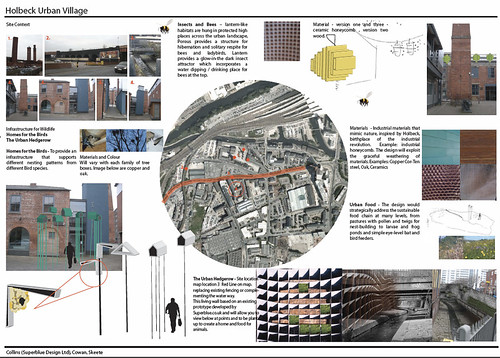
Holbeck Designs short-listed

Our London design team, comprising Annick Collins (superblue) Gregory Cowan and Natalie Skeete, has have been shortlisted for the Holbeck competition scheme submitted in February. (Design Week)

The competition entry prepared by Collins Cowan and Skeete proposes a triadic strategy of landscape, urban 'furniture' and a palette of suitable materials, where non-humans and humans will interact. The final result is due to be announced on the 28th of May.

Designing animal habitats for Holbeck Urban Village seemed an excellent idea for a collaboration on a design competition. Annick, my engineer colleague, and one of a trio with whom I had worked on the Ken Saro-Wiwa Mobile Memorial competition, agreed to collaborate at the end of 2008. Near Camley Street , a model inner city nature interaction space, we talked over a pint of London Pride about human-animal and animal-human interaction in this 'urban regeneration' area, and found consensus on issues like biomimicry, and human-centred urban design principles which might also allow birds to nest, bees to pollenate, and otters to hide from human residents of the area. Architectural assistant Natalie Skeete, who had been working in the same regeneration area by the Fleet, and on the new Kings Place building by the canal, joined the team, adding her experience of nocturnal animal architecture.

A discussion about the transdisiplinary work of OOZ was brought my attention by a neighbour commentating on the work. Geese, Birds, Fish and Bats had been studied and discussion ensued about human and non-human interactions.

Our team finalised and submitted our three part strategy proposal in February, and in March our team was shortlisted, among a field of competitors from Yorkshire, California, and beyond. We met by the canal again to consider the shortlisting, and offered the competition organisers the opportunity that we would engage the local community. Our process-driven design strategy, which combines urban landscape, animal 'furniture' and a code of materials will not easily translate into a photo opportunity. The press article says "The winner, who will be announced on May 28, will see his or her vision turned into reality and installed in Holbeck Urban Village ready for local critters to move in." But do the organisers understand the need to work with the existing resident human critters?

Whether our scheme will be suitable for building a photogenic prototype for the 'critters' - as the organisers envisage - remains to be seen.

Links:

Sunday, 15 March 2009

Bogota


PBS has screened a 25 minute segment about rapid urbanisation, informal settlements, and recent development in Bogota. Although exaggerated in its style, and narrated grandiosely by Brad Pitt, the story of the reintroduction of pedestrian and bicycle priority for city transport is poignant, and Mayor Peñalosa's reassertion of the importance of human centred accessways, footways, cycleways, and public transport systems are explored. The introduction of walking programmes and bike lanes, and the political resistance to these by business is addressed, including the controversial but laudable practice of prioritising footway and cycleway construction for the majority over roadway construction for the few.

Tuesday, 10 March 2009

Brazil

I was on a high after tasting the mild, fruity and spicy Brazilian grind of the day at Monmouth Coffee in Covent Garden this morning, following a nine o'clock meeting. It was an appreciated pick up after the previous evening's amazing party for the 15th birthday of Stranger and Stranger, at a well stocked venue in Little Portland Street.

At the meeting with the Quantity Surveyor in Bloomsbury Square this morning, I was accompanied by a more experienced architect colleague, to see the tender documentation of a project in Kings Cross, which I would like to work on. Among many topics, we discussed facade detailing, window specifications, and changes of planning use in the building. I learned a little more about section 106 agreements. Tenders will close this week, and no doubt some interesting issues will arise around the contracting, costing and project planning, given the current climate of the construction and property markets.

Leaving my friend at Seven Dials, I returned via St Giles Circus and walked through the delightful British Museum court to Russell Square. Hordes of student teachers congregated around the brutalist front of the Institute of Education in Bedford Way, and I continued past Ghandi in Tavistock Square, through Woburn Walk, around Argyle School, and back to my office.Link